UNSW
Enabling Personalised Experiences
Helping a large Australian university reshape how it planned, coordinated, and delivered digital experiences. Defining the operating model for audience-first personalisation across a complex, fragmented ecosystem.
Making audience-first digital experience more than a campaign aspiration
UNSW came to Accordant with a systemic problem. Digital experiences were being delivered in silos, audience data was fragmented, and there was no shared model for coordinating delivery across the organisation. The brief was not about a single campaign or channel. It was about defining the structures, workflows, and capability needed to deliver more connected, audience-led experiences at scale.
At the same time, audience expectations were shifting. People increasingly expected digital experiences that were personalised, responsive, and coherent across channels. Meeting that expectation required the organisation to rethink not just the experience, but the operating model behind it.
The challenge
The problem was systemic rather than channel-specific. UNSW's digital ecosystem was fragmented across faculties, business units, and delivery teams. Parallel and uncoordinated approaches to the same audiences, a wide mix of platforms and execution systems, and no single customer view made it difficult to design seamless journeys, coordinate delivery across teams, or scale personalisation in any meaningful way.
Getting better at personalisation was not, in the first instance, a tooling or design problem. It was an organisational one.
What I was responsible for
Ecosystem mapping
Mapped the current-state service ecosystem across teams, platforms, and audience touchpoints to make visible where silos, duplicated effort, and fragmentation were blocking coordinated delivery.
Experience strategy
Synthesised stakeholder, organisational, and market inputs into a clear experience strategy, reframing the conversation away from internal channels and towards audience needs.
Operating model design
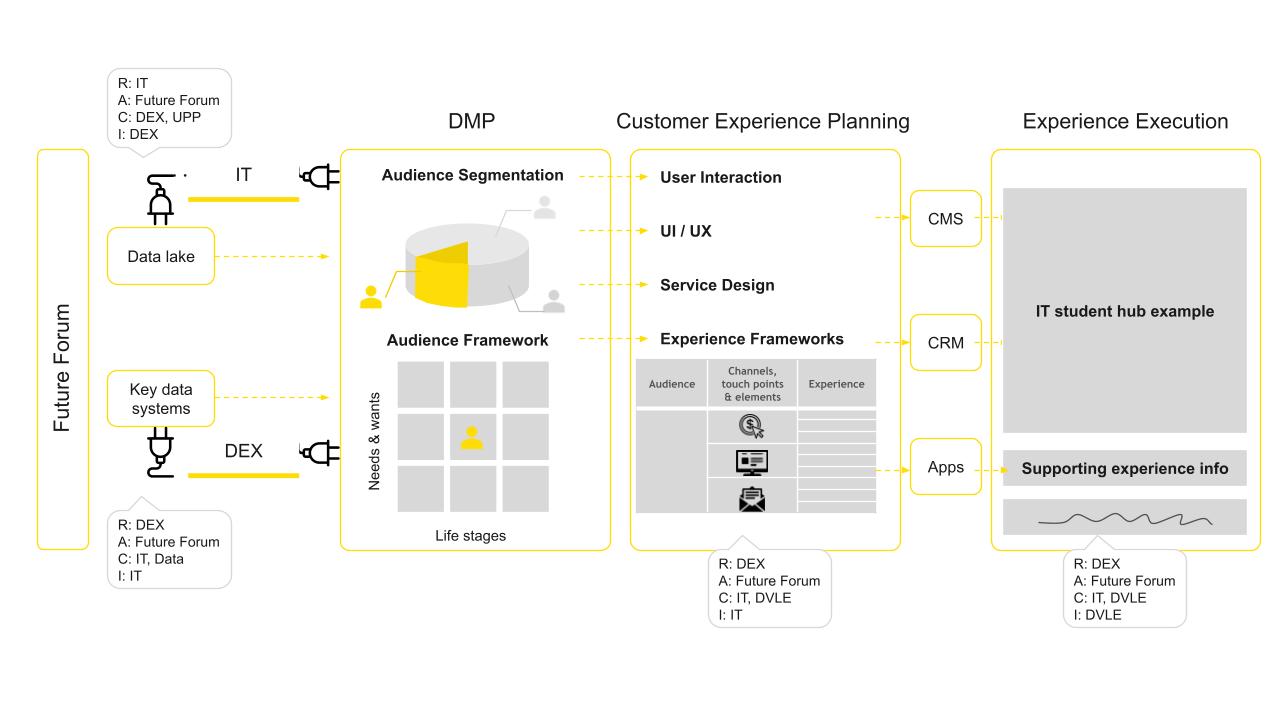
Helped define a future-state operating model connecting audience segmentation, service design, interaction design, and channel execution into a clearer end-to-end process for audience-first delivery.
Structure and capability
Shaped recommendations for an audience-first team architecture, governance model, and capability roadmap so that personalisation could be embedded as an organisational practice rather than a one-off tactic.
How do you make a complex digital ecosystem legible, and actionable, for the teams who need to deliver it?
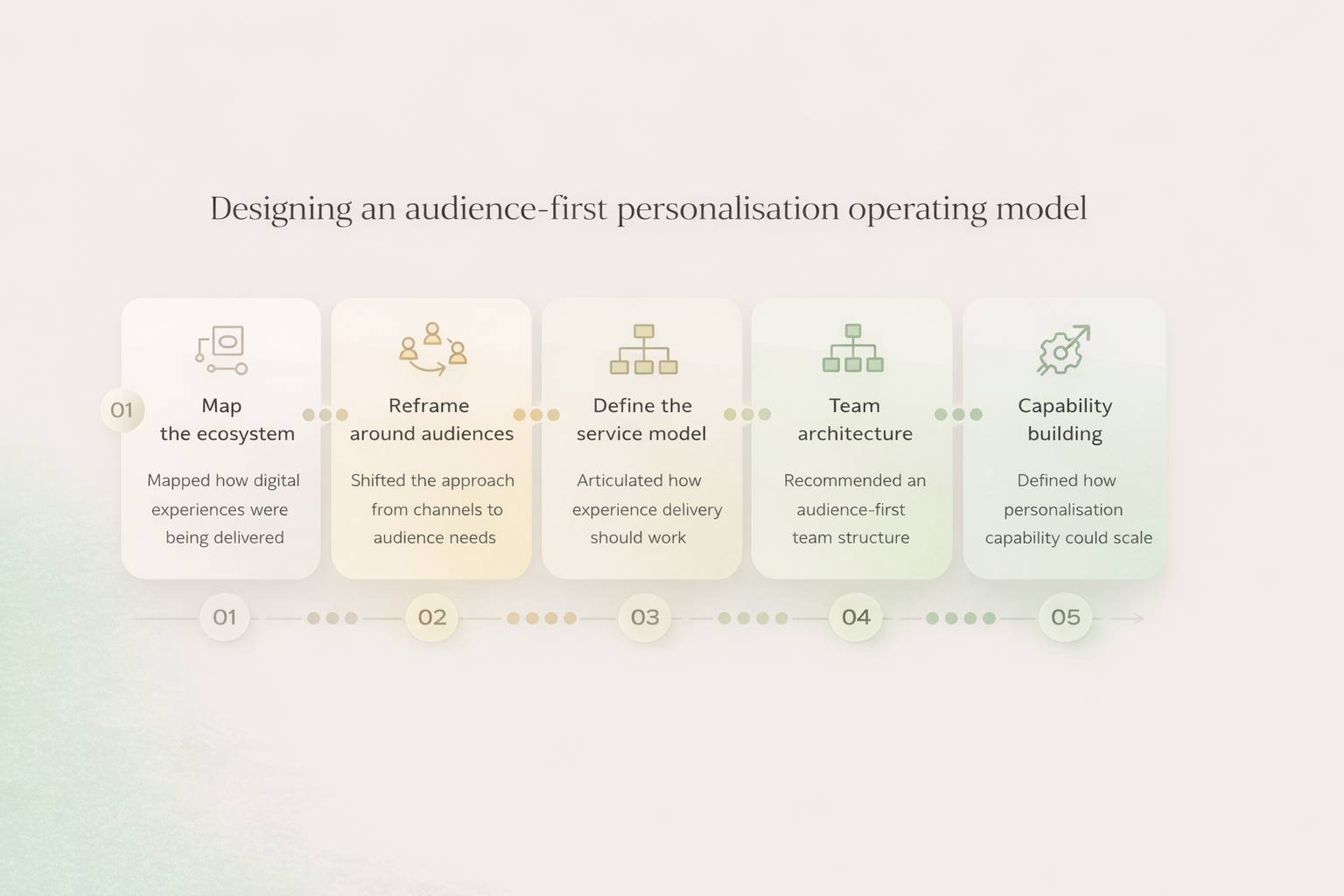
The work was structured around five interconnected workstreams: mapping the current state, reframing around audiences, defining the service model, recommending a team structure, and building the foundations for capability growth. Each step had to be visible and useful to a broad set of stakeholders, not just legible to consultants.
Approach
The project moved through five structured workstreams, each building on the last. The aim was not just to produce a strategy document, but to build the shared understanding and practical frameworks that teams could actually use.
Mapping the current ecosystem. Analysed how digital experiences were being delivered across the organisation, looking at audiences, interactions, operations, services, structure, and culture. This made visible where silos and platform fragmentation were blocking coordinated delivery.
Reframing around audiences. Shifted the strategy away from internal channels and towards audience needs. Defined a model where core audience groups would be guided through more integrated digital experiences, supported by the right operational foundations.
Defining the service model. Articulated how experience delivery should work across data, systems, teams, and execution, connecting audience creation, segmentation, planning, service design, and channel execution into a clearer end-to-end process.
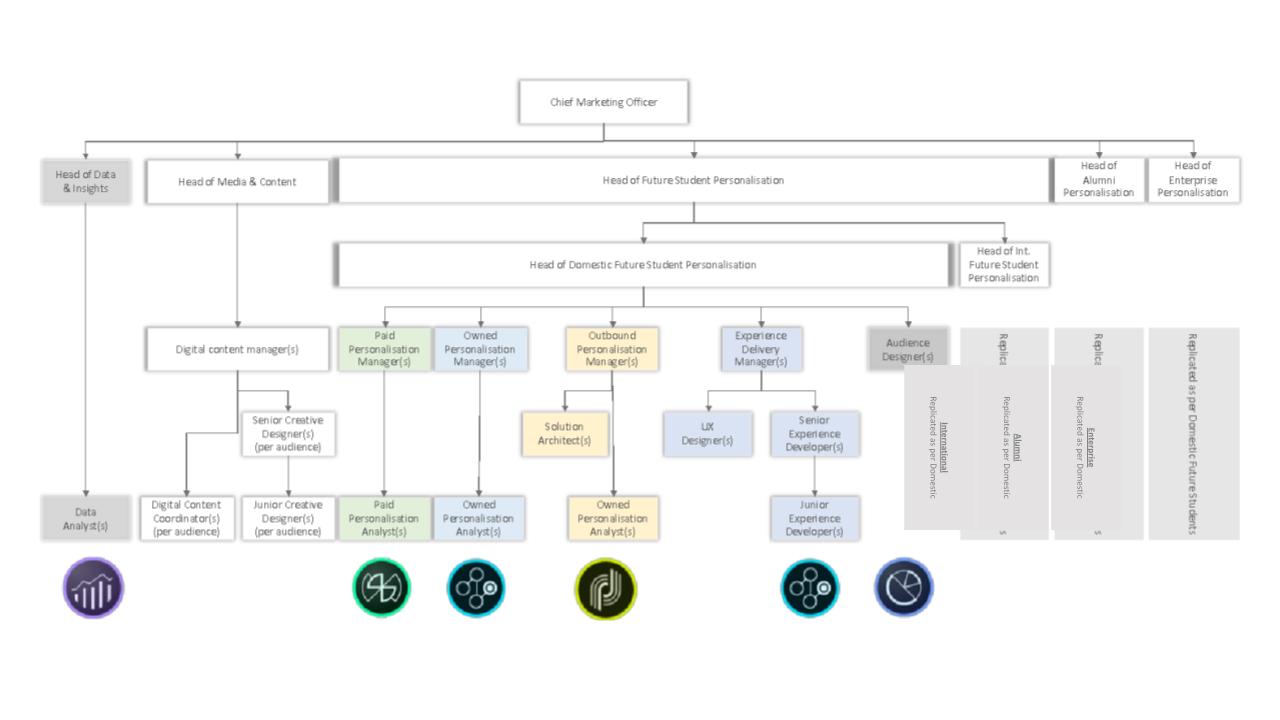
Recommending a future-state team structure. Proposed an audience-first team architecture designed around major audience groups rather than siloed channel functions, creating a clearer model for ownership, coordination, and more efficient personalisation delivery.
Building foundations for capability growth. Set out how capability could mature over time, spanning governance, operating rhythm, platform enablement, data foundations, and cross-team collaboration, so personalisation could become embedded as an organisational practice rather than a campaign tactic.
Key design question
How do you design an operating model for a large, decentralised organisation that teams with different priorities will actually adopt? The challenge was not producing a theoretically correct framework. It was producing something concrete enough to act on, flexible enough to survive contact with the organisation, and clear enough that multiple stakeholder groups could see themselves in it.
What was produced
Current-state ecosystem map
A documented view of how digital experiences were being delivered across the organisation, showing teams, platforms, audiences, and the gaps between them.
Audience-first service model
Frameworks connecting audience segmentation, planning, service design, and channel execution into a clearer and more coordinated delivery process.
Team structure recommendations
An audience-first team architecture model designed to improve ownership, reduce duplication, and support more efficient cross-channel personalisation delivery.
Capability and governance roadmap
A maturity model spanning governance, operating rhythm, platform readiness, and data foundations, giving teams a staged path for embedding personalisation at scale.
Why this project matters
The project gave UNSW a clearer operating model for delivering audience-first digital experiences, a shared view of the service ecosystem across teams and systems, and a practical path towards more coordinated, scalable personalisation.
More broadly, it demonstrated that personalisation challenges in complex organisations are rarely solved by better tooling or sharper creative. The constraint is almost always operational: unclear ownership, fragmented data, and delivery structures that were not designed with connected experiences in mind.
Created a clearer operating model for delivering audience-first digital experiences across the organisation.
Made the service ecosystem visible across teams, systems, and delivery stages for the first time.
Recommended an audience-based team structure to improve coordination and reduce duplicated effort across siloed teams.
Helped establish the structural and capability foundations needed for cross-channel personalisation at scale.
Gave stakeholders a shared framework for aligning audience strategy, service design, and execution.
What this says about how I work
I treat personalisation as an organisational design challenge, not just an experience one
Personalisation only works when the operating model behind it supports it. The most important design decisions in this project were not interface decisions. They were structural ones: who owns what, how teams coordinate, and what shared frameworks make consistent delivery possible.
I make hidden systems visible before trying to improve them
Service design is often about making existing complexity legible across teams that have only ever seen their own part of it. The ecosystem map was useful not because it was comprehensive, but because it created a shared view that had not existed before.
Lasting change needs governance and structure, not just better tooling
The capability model was designed to outlast the engagement. The goal was for personalisation to become embedded as an organisational practice, with the right operating rhythm, data foundations, and governance to sustain it. Tools without those foundations do not hold.
From Repayment Tool to Everyday Finance
Redesigning the app, launching Pay In-Store, and building the product foundations for Tinka's next phase of growth.