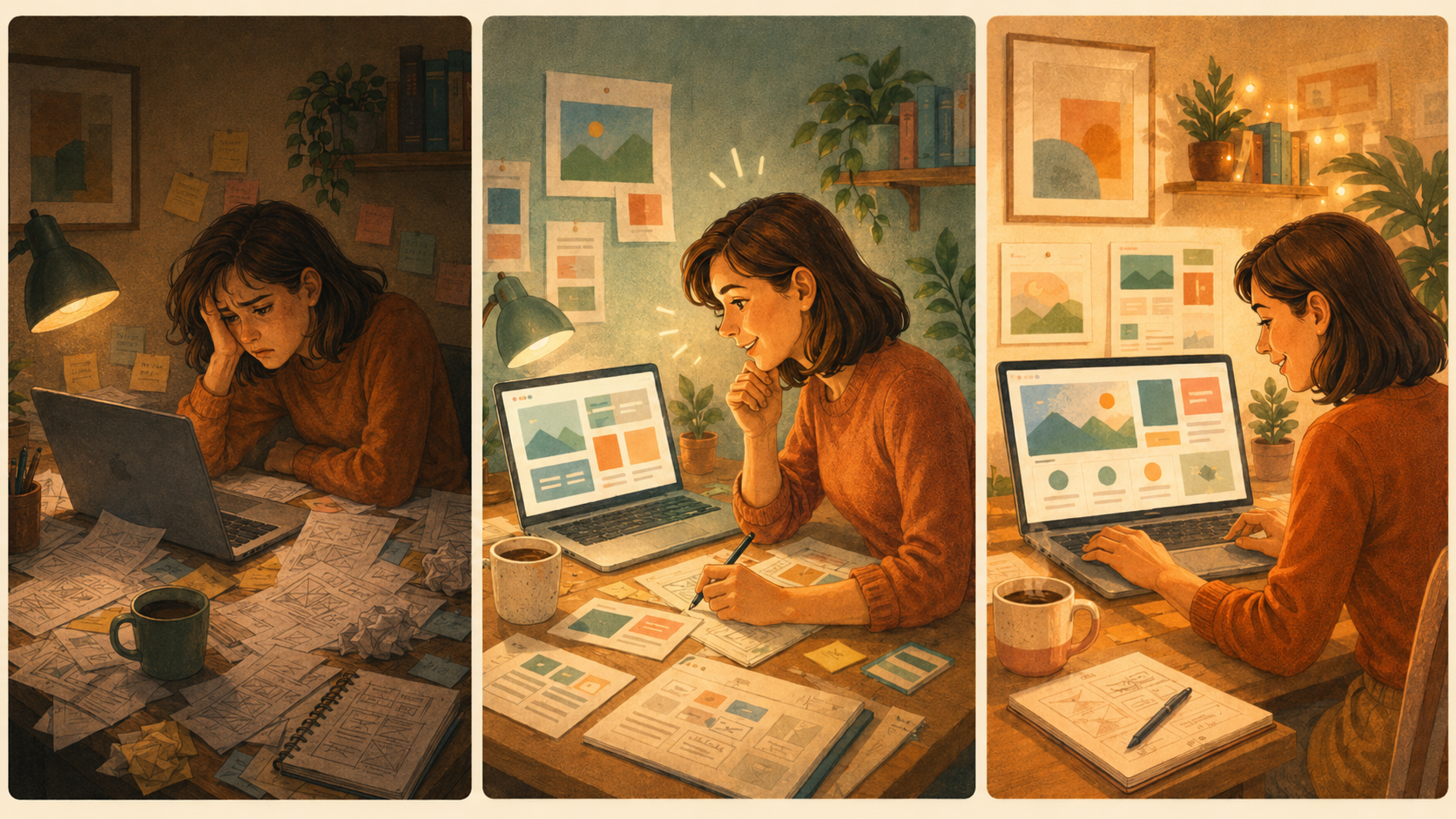
There's a particular kind of dread that comes with building your portfolio as a designer. It's not like other work you avoid. It sits differently. It whispers that you're not quite the right designer for the job. That your skills, especially the ones of strategy, problem solving and understanding people, don't fit neatly into a website. That you need to become someone else to make something worth showing.
I felt that dread for a long time.
And honestly, I think a lot of designers do. We just don't talk about it.
The pressure is real. On LinkedIn, you scroll past these immaculate portfolios with perfect case studies, polished visuals, compelling narratives. You read all the advice that says your portfolio is what gets you in the room, so it has to be more than good. It has to be exceptional. And if you're a senior designer like me (someone whose work happens across strategy, problem-solving, and leading teams)there's an added layer of complexity. Some of my best work lives in process, in the invisible infrastructure of how things work. But a portfolio is visual. It's surface. It's exposure. And I wasn't sure I could bridge that gap without pretending to be someone I'm not.
On top of that, there's comparison. You start measuring yourself against these finished pieces. You start wondering if your work is good enough to put out there. You start feeling small. Not because your skills aren't strong, but because portfolios seem to require you to operate outside your natural strengths.
I think portfolio culture can be a bit toxic that way. It tells you that if you can't do everything yourself, you're not a complete designer. It creates this myth that the work you do alone is the work that matters most. But that's not how design works for most of us. We work on teams. We collaborate. We specialise. And yet a portfolio asks you to do it all solo.
I wanted my portfolio to exist. I wasn't sure I wanted to be the person who had to build it.
Then something shifted. It was small at first. I saw someone mention building a portfolio with Claude Code. I watched a video of the process. And instead of feeling intimidated, I felt curious. What if I didn't have to do this alone? What if there was a way to handle the parts that weren't my strength so I could focus on the parts that were?
I started experimenting. Claude Code. ChatGPT. Variant AI. I treated it like a collaboration instead of a cheat code. Within five minutes, I had a working portfolio. It wasn't perfect. It was using default design systems. But something in me just sparked. It wasn't relief. It was curiosity. And then excitement.
I went back and did it again, properly this time. I wanted to understand how to build it. I wanted to learn. And as I started working through the process, I realised I wasn't just building a website. I was learning how to code. I was learning how to use these tools together. I was learning how to collaborate with AI in a way I'd never done before.
The token limits I kept hitting frustrated me at first; but eventually they challenged me to think differently about how I was asking for help. Every day, I couldn't wait to work on the next page, the next component, the next piece of the story. It went from something I was dreading to something I was genuinely excited about. I'd wake up thinking about it. I'd be eager to start.
What surprised me most wasn't that the portfolio came together quickly. It was what I learned about myself in the process.
I realised I'm not just an Experience Designer. I'm someone who can learn to build things. I can understand code. I can make strategic decisions about design systems. I can think like a product builder. I can work across disciplines. I'm broader than I thought.
The portfolio became proof of that. But it's not just about the output. I'm proud of what I made, yes. But I'm equally proud of the process. Of what I figured out. Of what I can do now that I didn't think I could do before.
When I showed it to my family and friends, I wasn't embarrassed. I was proud. Not just of how it looked, but of the journey. Of the learning. Of the fact that I pushed through something I'd been avoiding for years.
I know there are designers out there feeling what I felt. Avoiding the portfolio work because it feels too big, too hard, or because you don't think you're the right kind of designer for it. Or because you're on LinkedIn and you feel small. Or because you work on teams and the idea of doing it all alone feels foreign.
Here's what I want you to know: you don't have to do this the way everyone else does. You don't have to spend months hand-crafting every pixel. You don't have to be a visual designer to have a portfolio that works. You can, and should, use the tools available to you. They're not here to take over the work, they're here to handle the parts that slow you down so you can focus on what actually matters. Your story. Your work. Your voice. The parts that are actually unique about you.
The tools don't diminish your work. They amplify it. They let you skip the parts that drain you so you can focus on the parts that matter.
I'm still figuring out the best ways to use these tools. I'm still learning what's possible. You can bet that the portfolio was just the beginning.
If you're putting off your portfolio, or if you're dreading it, I'd encourage you to try a different approach. Don't be scared of the tools. Don't compare your portfolio to someone else's. Build something that feels true to you. See what you learn about yourself in the process. And see what becomes possible when you stop fighting the work and lean into it.