Booking.com
Mystery Deal
Explored and de-risked a high-uncertainty product concept for Booking.com, defining how far opaque travel could go without breaking trust or conversion.

Designing desire without complete information
Booking.com explored whether opaque travel could unlock new demand without compromising trust or conversion. The opportunity was not just to design a new experience, but to define whether this type of product should exist and how far it could be pushed.
The core question was simple: how much can you hide before the experience stops converting? This required balancing intrigue with clarity, and emotion with confidence, in a product category built on transparency.
The challenge
The challenge was not interface complexity, but product risk. Introducing uncertainty into a platform built on clarity required careful control of trust signals, pricing perception, and user confidence.
We needed to define a model that could generate excitement without creating hesitation, and ambiguity without reducing conversion.
What I was responsible for
Design space leadership
Led the exploration and structured the concept development process, defining the range of viable product directions before converging on a recommendation.
Prototype development
Built interactive prototypes as tools to test genuine behavioural responses to booking under uncertainty. Each direction was built at sufficient fidelity to produce real user reactions, not hypothetical ones.
Trust signal mapping
Mapped reveal strategies and identified which trust requirements were load-bearing in the commitment decision, by segment and by reveal position.
Product direction
Defined the conditions under which the product could work, enabling confident product decisions rather than continued broad exploration.
How do you sell a product when the product itself is the surprise?
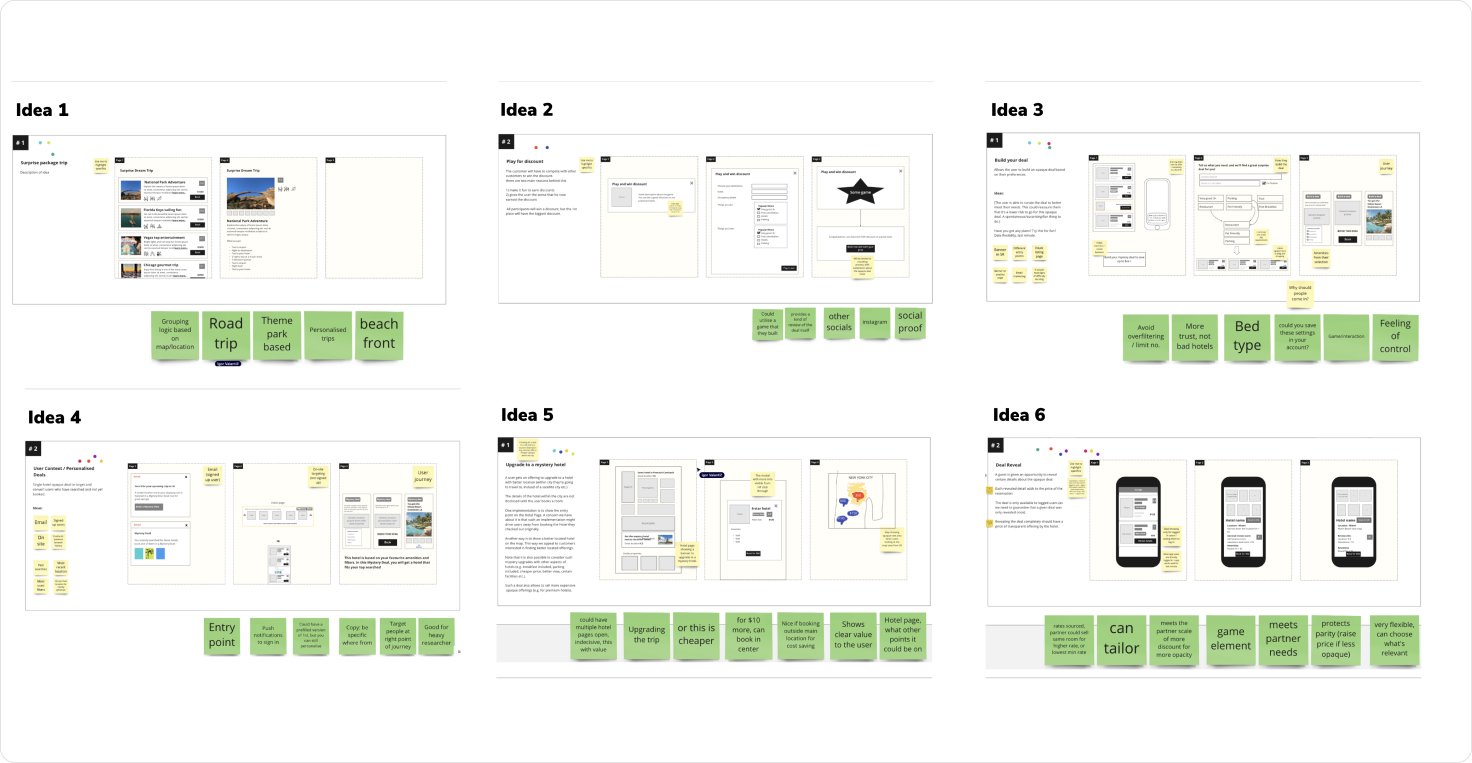
The seven concept directions weren't arbitrary. They were mapped systematically across a reveal spectrum to test whether the viable design space was narrow and specific, or broad enough to support a segmented product with different depths of opacity.
Approach
Rather than converging on a single design direction early, the brief was deliberately exploratory: map the full viable space first, then narrow. The seven directions were positioned to test different assumptions about what makes an opaque product compelling versus anxiety-inducing.
Reveal spectrum mapping. Seven concepts were positioned across a reveal spectrum, from "city known, hotel unknown" through to "full surprise revealed at the airport." This clarified the trust, desire, and conversion implications at each position, revealing that no single reveal strategy worked across all segments.
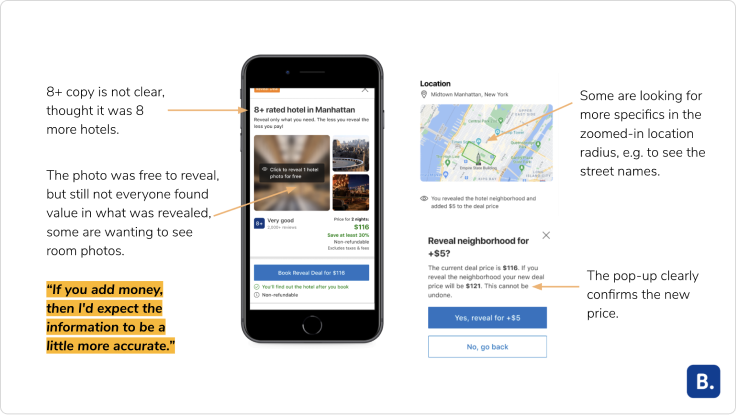
Trust signal research. Rather than assuming which guarantees users needed to feel safe, this revealed which specific signals were actually load-bearing in the commitment decision: discount depth, star floor guarantee, neighbourhood assurance, and cancellation flexibility. Each segment weighted these differently.
Segment-specific adaptation. The research clarified that different traveller types had fundamentally different trust thresholds and risk tolerances. This defined whether a single product could serve all segments, or whether opacity needed to be positioned as a distinct offer.
Brand integration. Each concept was designed within Booking.com's visual and interaction system. This allowed us to understand whether the mystery framing felt like a natural extension of the brand or a departure from it, establishing the brand guardrails before any product direction was finalised.
Key design question
Which specific piece of information, if withheld, crosses the line from intriguing to anxiety-inducing? And does that threshold differ enough across segments to require a segmented product? The answer was yes. The guarantee architecture that worked for spontaneity-seeking couples would not have worked for families, and the pricing transparency that family travellers needed undermined the mystery framing for other segments.
What we built
Structured prototype directions
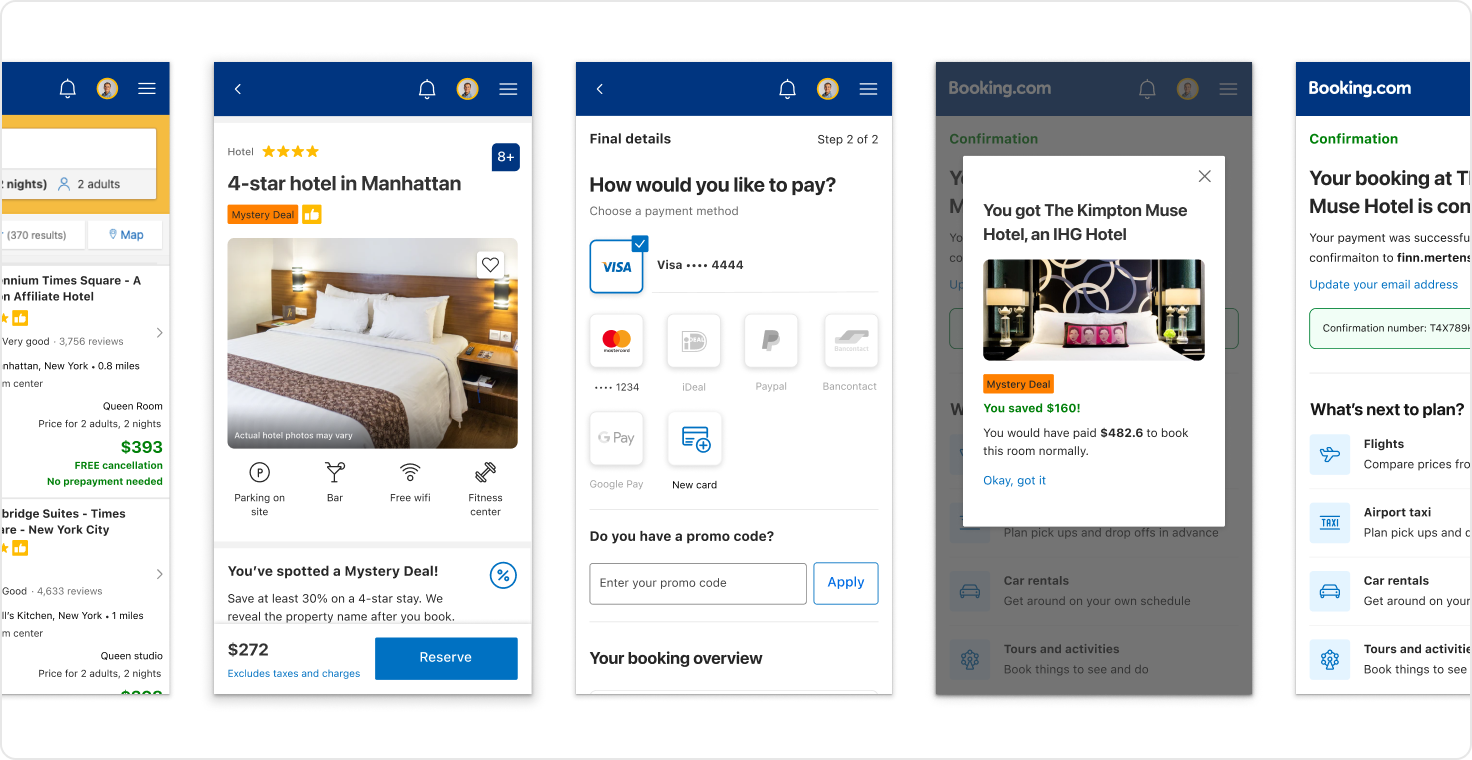
Seven interactive prototypes built to test genuine behavioural responses to booking under uncertainty, not hypothetical reactions to a description. Each was positioned to test a specific assumption about trust, desire, and conversion.
Trust signal mapping
A documented map of which information elements were load-bearing in the booking commitment decision, ranked by segment and reveal position. This replaced assumption with evidence.
Behavioural insight patterns
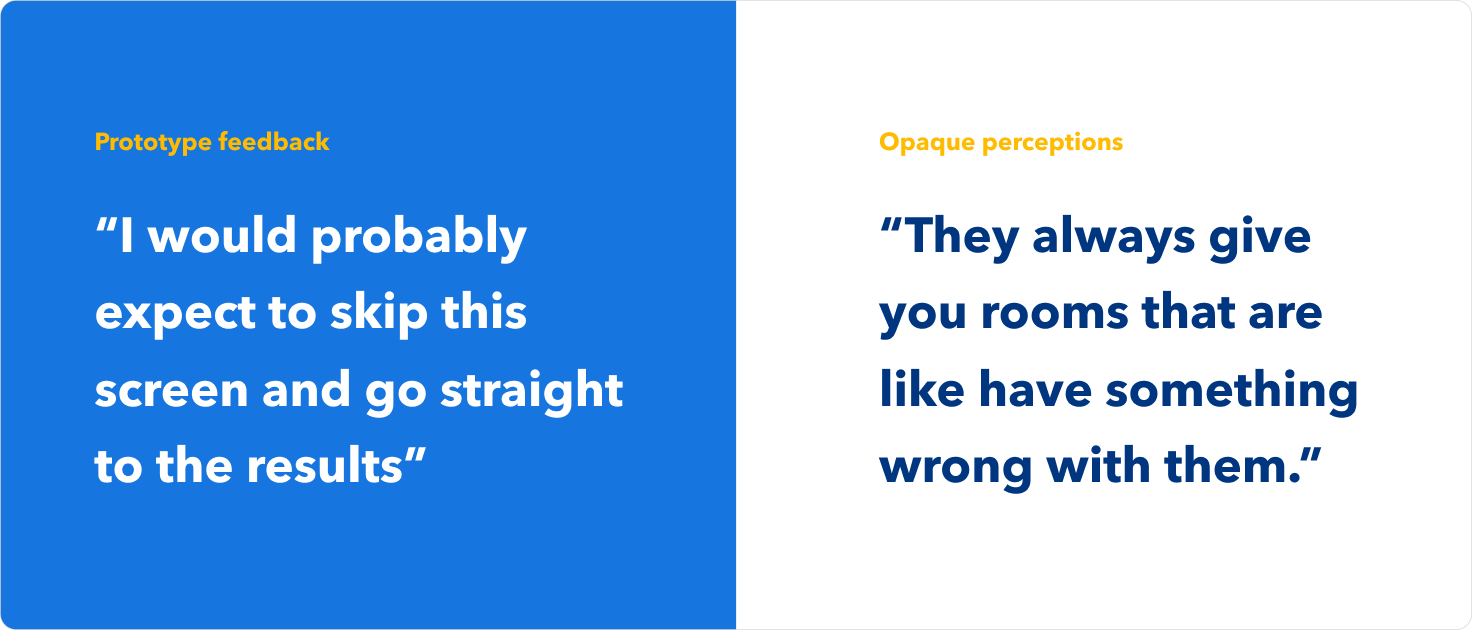
Specific findings on how and when revealing information affects anticipation, confidence, and willingness to book. These defined the minimum disclosure required to support conversion at each reveal position.
Product direction clarity
A clear picture of the viable design space: which directions could work, which could not, and what conditions were required for the product to convert without eroding brand trust.
Why this project matters
The exploration directly informed a Mystery Deal product that was subsequently launched in the US market. While exact performance metrics are confidential, the work established the conditions under which opaque travel can convert.
It clarified the balance between intrigue and trust, and defined the minimum information required to support user confidence. This reduced product risk and enabled the team to move forward with a focused and validated direction, rather than continuing broad exploration.
7
Distinct prototype directions produced and tested, mapping the full viable design space before converging on a direction.
3
Traveller segments with distinct trust thresholds clarified, enabling a segmented product strategy.
1
Mystery Deal product subsequently launched in the US market, informed by this exploration.
This project reflects how I approach high-uncertainty product problems
I start with the product risk, not the UI problem
In high-uncertainty products, the right first question is what needs to be true for a user to commit. Answering this before designing a screen means the design has a clear job to do, and a clear way to measure whether it is working.
I use broad exploration to reduce the risk of premature convergence
Seven directions feels like more than necessary until you realise the answer is often in combining two of them. Mapping the full space first is how you avoid investing in the wrong direction and carrying that cost forward.
I treat trust as something built cumulatively through the flow
In high-uncertainty products, trust is not established once by a brand name or a badge. It is earned at each step of the booking experience, and it can be lost at any single point. This shapes how every design decision in the flow is weighted.
UX Optimisation Work
Experimentation and conversion-focused design across education, finance, e-commerce, and SaaS.