Decathlon
AI × Design
Enablement
Building internal capability and confidence around AI tools through a practitioner-led newsletter, practical tool evaluation, and supporting enablement across Decathlon's design organisation.
Making AI practical for designers who need to ship, not research
Most organisations approach AI adoption the same way: mandatory training, abstract tooling presentations, a top-down directive to start using AI. What they get is surface-level compliance and zero genuine fluency. The challenge at Decathlon was different: build a practice that designers would actually want to be part of.
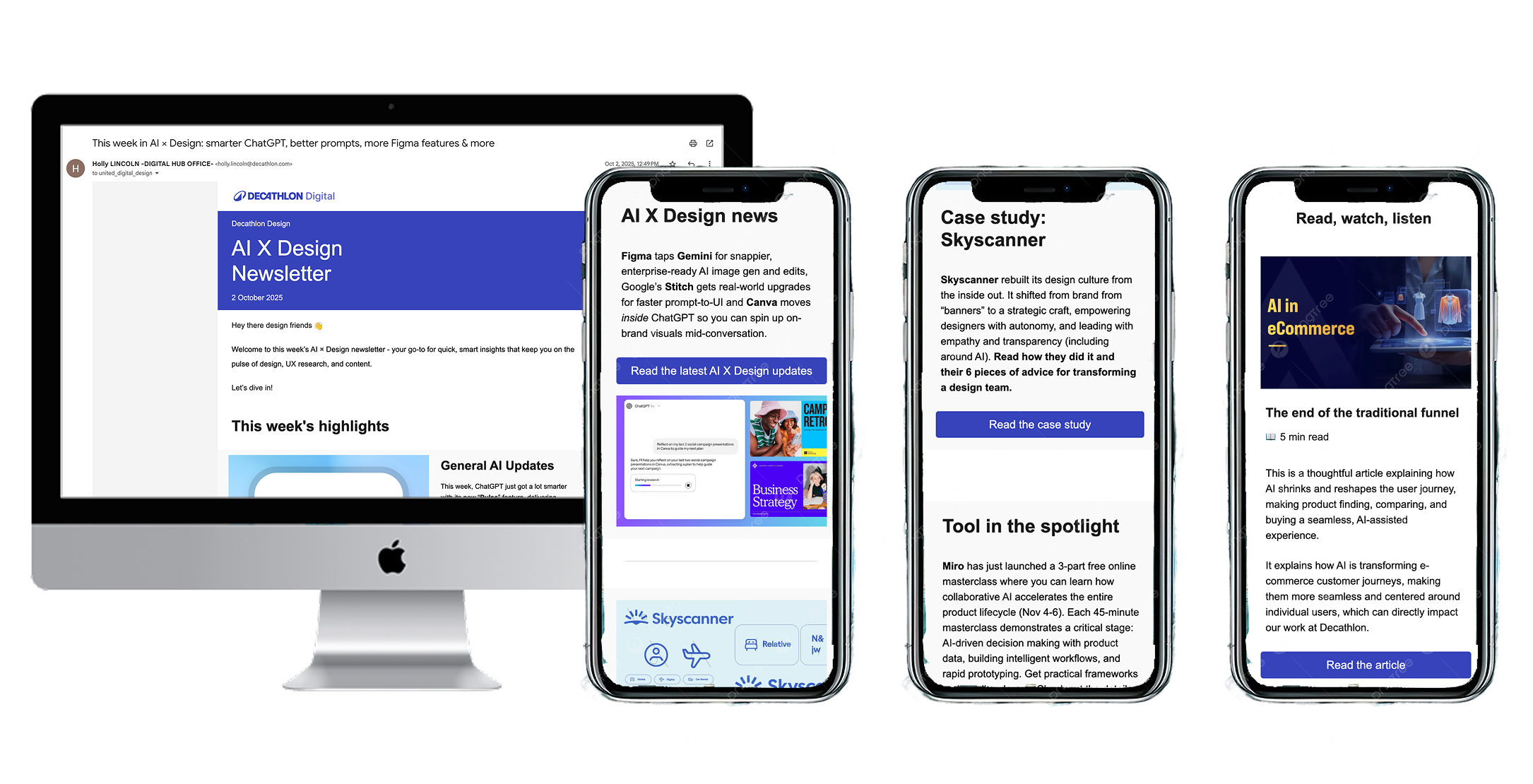
I founded and ran the internal AI × Design newsletter, not as an official transformation initiative, but as an organic, practitioner-led resource for designers. The goal was to make AI tools immediately useful, visibly relevant to real design work, and accessible to designers at every level of technical comfort, while also supporting broader enablement conversations already happening across the organisation.
The challenge
Design organisations at the scale of Decathlon face a specific adoption problem. There are too many AI tools for any one person to evaluate, the quality and relevance varies enormously, and the pressure of day-to-day delivery leaves little space for experimentation. Without a curated, trusted resource, most designers default to ignoring AI entirely, or using it in ways that don't actually improve their work.
The challenge wasn't making AI available. It was making AI worth reaching for in the middle of a real project, under real time pressure, for a designer who had never tried it before.
What I was responsible for
Newsletter
Founded and edited a regular internal AI × Design publication covering tool evaluations, practical workflow experiments, use cases grounded in real design work, and useful links from the broader design and AI community.
Enablement support
Supported AI × Design workshops and internal direction-setting by contributing practical examples, tool knowledge, and designer-centred perspectives grounded in day-to-day workflow needs.
Tool evaluation
Evaluated AI tools for design relevance, workflow fit, learning curve, and practical utility, producing honest guidance rather than vendor summaries, including what worked and what did not.
Community momentum
Helped create the conditions for shared learning within Decathlon's design organisation, giving designers a trusted, low-pressure entry point into AI through regular, useful, practitioner-led content.
How do you build genuine AI fluency without it feeling like mandatory training?
The difference between mandatory training and genuine adoption is trust. The newsletter worked because it was practical, honest, and written from inside the design workflow. It helped make AI feel useful and approachable, rather than abstract or imposed.
Approach
The approach was built around one principle: make AI immediately useful, not theoretically interesting. Every newsletter issue, every tool recommendation had to pass the test of "would a designer reach for this on a real project, today?"
Practitioner-first framing. The newsletter was written by a designer, for designers, not by a transformation team. Honest about what worked and what did not, which built trust quickly and kept the readership growing through word of mouth rather than mandate.
Workflow-first tool coverage. Instead of reviewing AI tools by capability, tools were evaluated by workflow momennt (ideation, research synthesis, presentation, handoff documentation) making it immediately obvious where to try something and what to expect.
Practical support over passive awareness. The wider enablement effort worked best when designers could connect tools to real workflow moments, see credible use cases, and build confidence through examples they could immediately try.
Cumulative community. The newsletter created a shared vocabulary and shared reference points across the design team. Conversations about AI tools became ordinary rather than exceptional, which was the goal.
Key design question
How do you make something worth investing time in when time is the one thing a design team doesn't have? The answer was to make every touchpoint immediately useful; not promising future benefit, but delivering value in the five minutes it took to read an issue or the hour it took to attend a workshop. If it wasn't useful right now, it wasn't earning its place in a designer's day.
What we built
AI × Design newsletter
A regular internal publication covering tool evaluations, workflow experiments, and practical use cases (written by a designer, for designers) honest about what works and what doesn't.
Practice infrastructure
A community of practice with shared resources, a growing tool library, and peer-to-peer knowledge exchange that continued to develop beyond any single session or issue.
Why this project matters
The newsletter reached 100+ regular readers within the design and product organisation, growing through peer recommendation rather than mandate, which meant the audience was genuinely engaged rather than passively subscribed. The workshop programme produced direct, hands-on AI experience for designers across the organisation.
More broadly, the project established that AI adoption in a design organisation requires a community infrastructure, not just a tooling decision, and that the most effective way to build that infrastructure is through a trusted, practitioner-led voice rather than a top-down programme.
100+
Regular readers of the internal AI × Design newsletter.
3
Mediums in which users could consume the content (email, g-chat & Google docs)
1
Internal AI × Design community of practice built from scratch.
What this says about how I work
I build practices, not just outputs
A newsletter that runs once is content. A newsletter that runs regularly, earns trust, and becomes the thing people forward to colleagues is infrastructure. The measure of this work was never a single issue, it was whether the practice could sustain itself.
I evaluate tools against real workflows, not feature lists
The question is never "what can this do?" but "when in my actual process would I reach for this, and would it make that moment better?" Framing tool evaluation that way is what made the guidance useful rather than academic.
I meet people at their actual comfort level
The designer who has never used an AI tool and the designer already building custom prompts need different starting points. Good enablement works for both, and the community only grows when the entry point is low enough to be genuinely welcoming.
CRO Compendium — UX Optimisation Work
Experimentation and conversion-focused design across education, finance, e-commerce, and SaaS.